Sunday, November 20, 2022

Suspiria (1977)


After making a name for himself with Giallo films, including the genre-defining Deep Red, Dario Argento began work on supernatural horror Suspiria, together with his partner Daria Nicolodi. It would become his other grand opus, and one of Italian horror's most memorable experiences...


Suzy Banyon is a young ballet dancer enrolling in the illustrious German Tanz Academy. Things get off to an immediately odd start when she sees a student muttering incomprehensibly before running away. News soon comes that she has been brutally murdered. Suzy gets used to the school, but slowly feels weaker and weaker. Her roommate gets suspicious, and begins her own investigation. When she too is killed, Suzy must work to save herself, and uncover the truth that lies beneath...


Suspiria is a fantastic supernatural horror, and gained instant recognition upon its release, both for its gorgeous imagery, and shocking violence. Managing to get itself censored or banned in a few places, it's now widely available in all of its uncut glory, as it nears 50 years of terror.


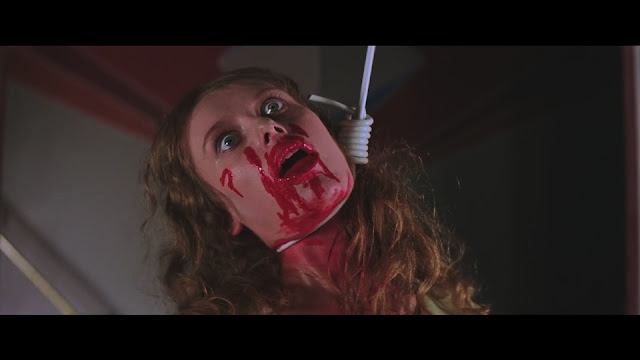
The plot to Suspiria is light, and feels like a classic fairy tale for an adult audience. Young girls, evil old witches, and untimely death. The most famous scene is the shocking beginning, that leaves you hooked and possibly squirming in your chair.

I like how the mystery unfolds, through the realisation of simple yet important details. As for the negatives, it feels like we're on the periphery of the story the entire time. Suzy is the protagonist, yet has no idea what's going on till the end. I guess that's the trouble with a story where every character who discovers the truth immediately dies. The film's a bit rudderless, with a protagonist who is unable to learn, or else she'd die!


The film makes absolutely no effort to delve into the world and mythology of these witches, or the Three Mothers. They just happen to be the cause of spooky events, and are in the shadows until the last 20 minutes. For a standalone film this isn't an issue, though when you take Suspiria into account as part of a greater trilogy, it is a disappointment. I guess you could see it as one entry to set up the atmosphere of the world, and the second for the story, but still, that's a lot of the overall trilogy wasted.

A neat fact is that Suspiria was originally meant to be about younger kids, which would fit even more with the fairy tale motif. But understandable concerns grew over children being involved in such violent setpieces. Granted, one of the victims is a teacher, and Pat could've always been older, but still. I am glad the characters were aged up.


Suspiria is well-known for its almost surreal nature. Illogical is another, less-generous word that comes up. When you really think about it, there are quite a few things that don't make much sense. How did a magical school get a maggot infestation? How did they even infiltrate Mater Suspiriorum's secret room? And why is the directress casually sleeping in a tent with all the other students? And what kind of dance schools keep rooms full of barb wire? Lots of little illogicalities you might wonder about, and they may not have satisfactory answers, but they're nothing that truly hurts the film.

The characters are a weak link. Suzy is a strong protagonist, but spends much of the movie drugged, and only comes into her own in the final act. Her roommate Sara picks up the slack, and is a good co-star. We briefly get to know Pat and her (somewhat overreacting) friend before their deaths. We also get short but rewarding scenes with a couple of experts near the end.


We have an abundance villains here. Miss Tanner, Madame Blanc, and the reclusive Helena Markos (aka coven leader Mater Suspiriorum). None of these characters get any exploration, and don't do much oscreen. The worst is Markos, who only has one scene, barring an earlier cameo as a snoring silhouette. It would've been better I feel if she'd been combined with Blanc or Tanner, so the film's true villain could have been a presence throughout, instead of a loud sleeper.

An interesting, and entirely underused character is fellow student Olga, who is clearly the bitchy one. You might expect her to be a constant presence, bullying the leads, or to turn out to be part of the coven. Instead the actress must have broken her ankle or something, because she vanishes 20 minutes in and is never seen again. Her personality is pretty interesting to think about. She's a forceful and mean girl, yet a word from the madames is enough to get her to play ball. It makes you think how much she's part of the coven. The lack of screetime actually helps paint a mysterious picture.
 

There is also the suspicious kid Albert (The dog clearly knows something's up with him, and tries to take action), who also disappears, the creepy butler, and a hunky male student. He seems nice enough, but the film has no romance. Quite a relief, really, since the film stands well without one. Perhaps that's a holdover from the characters originally being children.

Who the killer even is in an interesting mystery. Obviously it's the coven orchestrating the murders, but they are committed by an unseen figure. All we get a glimpse of are some cat-like eyes, and a hairy arm, making you wonder. Is it an actual character in the film? A monster? A psychic manifestation of evil?
 

The direction in Suspiria is superb, with the camera capturing many great angles and images. The lighting and colour go hand in hand to creating the film's unique atmosphere. The frames are awash in red, green, blue, and other rich colours. It does get a bit silly when you really think about it, like why does this taxi have a multicolour light? But that's easily overlooked when it turns out this good.
The set design is great too, and plays into the visuals. We have the academy's ornate front, the white and flowery head office, the almost surgical 'camp-out', and more. The set for the school was modelled after a real place, but Argento used a facade here. Naturally, since the board may object to the front of their school getting blown apart for a movie.


The effects in Suspiria are another high point, making for a masterwork in gore. The blood is bright red like paint, and it manages to convince in every scene, if a little rubbery in places.

My only complaint with the deaths is that they're not as evenly spaced out as they could've been, with only three death scenes over the course of 98 minutes. Thankfully any good horror movie can keep its audience entertained even if there's only a small body count.


The cast is great. Jessica Harper is an effective lead, and gets across personality, even if she is asleep a lot. Stefania Cassini does well as the supporting heroine, while Alida Valli and Joan Bennett are nicely bitchy as the villains. Playing Helena Markos (aka Mater Suspiriorum) was an old prostitute found on the streets of Rome. Vocally it was Daria Nicolodi who did the performance, to goofy effect. Hats off to the lady herself though, a non-actress at age 90 to be caked in prosthetics just for one scene! Udo Kier has a small but nice role, though sadly dubbed in the English version.Then again this straight-laced character may have been hard to take seriously if he spoke in Udo's distinct voice.


The score by Goblin is one of Suspiria's highlights. The music-box main theme is soft and eerie, fitting the tone perfectly. It's such a classic tune that it's found life outside/beyond the movie, and is often used in ballet or ice skating performances, even making an appearance at an Olympic game! Kudos to that team!

On the other side of the spectrum is the loud and chaotic 'death' theme, which keeps building in intensity as it goes. We also get assorted electronic twangs and buzzes. The most notable being the zweep zwoop rescoring of the main theme over the end credits. Whether these fit with the fairytale vibe the film's got going for it is up for debate. I think some of it works, though the ending theme is a bit much.


All these years later, Suspiria is perhaps Dario Argento's best film, and is still a unique entry into the genre. Well worth watching for any horror fans...

Saturday, November 19, 2022

Curse of the Devil (1973)


In the Medieval era, a witchhunter successfully rounds up and kills a group of satanists terrorising the land. The survivors curse his family, so that one of his descendants will become a monster of the night. Hundreds of years later, wealthy landowner Waldemar Daninsky is the recipient of that curse, after a midnight affair with a lady on Walpurgis Night leaves him scarred with the bite of the wolf...


Curse of the Beast (El Retorno de Walpurgis) is a Spanish-Mexican co-production, and the 7th in the Hombre Lobo series. Spain's answer to The Wolf Man, helmed by local genre icon Paul Naschy. As per usual, the film presents a reset continuity, showing yet another new spin on tortured soul Waldemar Daninsky's story. No vampires this time, but satanists galore!


Curse of the Devil gets all the necessary things right. It's spooky, violent, and has a great Gothic atmosphere.

My biggest issue with the film is it's a little too basic. The hero becomes a werewolf, and kills a couple of people, then gets killed. That's it. I'm not asking that every werewolf film needs to be unique or groundbreaking, and oftentimes simplicity is best. But this feels like the bare minimum, and we could've gotten more.


Here's where I'll swing back to the positives though. While the actual onscreen werewolf time may be fairly short, it's paced and spread out so well that the movie never feels short of action.

The dialogue is pretty amusing and cheesy.
From Waldemar's ancestor: "Righteousness will win! Bitches I'll see all in chains!"
Local advice: "It's not a comforting thing to have an insane killer in your area."
And from the horny sister: "I came here a virgin. I'm not gonna leave that way!"


Curse of the Devil is the biggest downer of the series. I know that's an odd statement considering Waldemar dies in almost every single movie, but there was usually something to mitigate the tragedy (i.e. evil is destroyed, the girl finds a new boyfriend, etc). Here though there's not really any such luck, and the satanists are never punished either. This Waldermar came so close to a happy ending too! But the satanists doom him completely, with no cure.

You've gotta feel sorry for Waldemar here. Usually the werewolf curse strikes him at random, or he brings it on himself, but here he's genuinely just minding his own business when some assholes who bear a centuries old grudge decide to curse him.


The satanists start out as main villains, and even get a salacious sex scene with a demon, before sending their prettiest charge out to seduce and curse Waldemar. Once the deed is done she runs away...and is immediately caught and decapitated by a roving maniac! There's instant karma for you! After this the other satanists are out of the picture. It's a shame we never see them punished, but at least this means the film's never too overcrowded.

Waldermar's new neighbours are a family from the big city. An older gentlemen, his wife, and two grown daughters. There's main love interest Kinga, and horny younger sister Maria. The former is fairly standard, and falls head over heels for Waldemar, while the latter... Her funniest moment comes when she strips nude and comes onto him. Waldemar looks sad about it, but has sex with her anyway! I'd call him a cheating louse, but frankly, she only has one scene left before she dies, and he's inevitably going to die tragically too, so I'm all in favour of Waldemar getting laid as much as possible! The poor boy needs it.


The detective is a difficult guy, and brings his fate on himself, but I felt kinda bad for him by the end. He has to deal with a maniac, an irate mob, and a werewolf, only to get torn to shreds!

Then there's Waldemar's faithful maid. So loyal in protecting her master, she's willing to kill the mysterious woman who showed up only days ago. Talk about mistrustful!


The film has a surprisingly high body count! Not counting the executions in the opening flashback, we get some stabbings, one decapitated satanist, a couple of mob killings, and over half a dozen werewolf victims!

The effects are a high point, with the werewolf make-up being as good as usual, perhaps the best it's been in these films. Definitely the furriest! The violence ranges from decent to hilarious, with the opening decapitation providing a lot of laughs!
 

Curse of the Devil is very well directed, and just goes to show how even cheap 'schlock' can look gorgeous in the right hands! The moonlit scenes are particularly good, with an effective mix of light and dark. The opening flashback is mostly in a sepia filter, which is thankfully not too intrusive, and gone before you know it.


Onto the cast. Paul Naschy does well, as usual. Bud Spencer's dub actor gets a serious lead role here. It's amusing hearing how a couple of the actors pronounce werewolf. The ladies all do a good job, and look drop dead sexy. Through them we also get to see how little women in the 70s shaved down there (Oh my!).

The score here is pretty good. It's ooky enough, and has some electronic twangs here and there, which sound neat, and don't clash as much with the classic Gothic atmosphere as you'd think.


Curse of the Beast is a fairly decent piece of Spanish horror. It's got a few issues, but none that make it worth avoiding. At its worst it's still a fun bit of Latin terror with monsters, blood, and ample nudity, so can you really complain?...

Monday, November 14, 2022

Xala (1975)


Ousmane Sembène is well-regarded in film-circles as one of the pioneers in African cinema. Hailing from Senegal, he began making movies after the country's decolonisation from the French. Unlike some though, he didn't think all problems were solved with their departure...


The French have been kicked out of Senegal and the locals have taken up the government themselves. Slipping easily into position, the old corruption continues steadily. Ruthless businessman El Hadji is celebrating his third marriage, but on the night of consummation, he's unable to get it up. After a few nights of failure, he realises he is cursed, and tries various means of removing it. While he searches, he neglects his duties, and the curse may be the least of his worries...


Xala (meaning Curse, of impotence) is a decent enough picture, and in some ways a great showcase for what the African peoples could do with film. It's well-made in general, and also well presented, getting across a pretty universal message, while also highlighting Senegal's specific issues.

The film has some pretty obvious but no less effective satire. The native Africans enter the government building for the first time in tribal dress...then 5 minutes later they've already swapped them out for their old 'master's' suits and ties. Disregard for local culture and adoration of foreign tastes is a big part of Xala. As for El Hadji, he ridicules his own people's beliefs (except when it can get him something), and boasts about kicking out the colonisers...while speaking French.


The others meanwhile are a bunch of snobs, who speak of fancy holidays to European nations, complaining that there are too many negros there now. They are uncaring about the Senegalese people outside their ritzy bubble, declaring cripples and beggars in the streets to be human rubbish. Meanwhile, the working class are downtrodden, like a Wolof magazine seller who makes no sales in his country's native language.


Xala is also a strong feminist film. Many of the women here are presented as strong, intelligent, and resourceful, leading the country into a better future. In contrast with the men, most of whom here are presented as corrupt, weak, and impotent.

Onto the characters. It's El Hadji's first family who get the most focus, from his frustrated but accepting first wife, to his rebellious and proud daughter. The kinda-jealous second wife disappears partway through and is never seen again (from what I could tell, since a lot of these characters blend together), while the third wife is a total non-factor. Despite being such an important part of the story, El Hadji's new young trophy wife has barely any dialogue, and zero personality. We never learn what she's making of all this, if she's happy or sad, brainwashed or clever. She disappears entirely after a while, and never gets a conclusion.
 

And lastly there is El Hadji himself. He's a bit of a ratbag, yet I feel the movie doesn't do a good enough job of showing it. Yeah we can plainly see he's not a very nice person, but there aren't really enough instances of him causing that much trouble. The worst we see is smacking his daughter for challenging him, he makes one slightly shady deal, and he orders some beggars to be relocated about an hour in, but that's it. It feels like we should have seen a lot more, because as it stands, he hasn't done enough onscreen to really warrant such a punishment. Because of this the comeuppance isn't as satisfying as it could've been.


Here is the biggest problem facing Xala, and it's nothing to do with the story itself-It's the runtime! In contrast with Sembène's earlier feature Black Girl, which ran at a brisk 55 minutes, Xala is a punishing 2 hours (plus change!). It feels like a really good 80 minute film that got dragged out far beyond its limit.


As a result, the pacing in Xala is often extremely slow, and we get an abundance of superfluous scenes, like cars pulling up and parking, or people walking. Lots of little things that could have easily been cut. When things are actually happening, like conversations, or important events, things move at a decent click.

Described in some places as a comedy, that's not entirely accurate. There are a few moments that might cause laughs, though it's not really a laugh-out-loud picture. It's never too dramatic though. The ending itself is a surprising moment. It's an amusingly gross way to end the film (and the sounds the actors make really highlight it!).


The cast do an alright job. Thierno Leye is a good lead, and the wives and daughter do well. The guy playing Ahmed was the best, and had a sense of Caribbean fun, if that makes any sense.

The soundtrack here is pretty good, though not perfect. I really liked some of the instrumental tracks, one in particular. It had a fun ring to it! Some of the ethnic singing can be a bit, uhhh...if I say grating, I won't start a war with Senegal, will I? Well they're not all bad in any case.

Sembène does a good job with the direction, and frames some shots very well. He focuses a bit too much on the mundane for my liking though, whether deliberately or not. I understand what a car looks like, stop showing me how they park!


Xala has its issues, and must, must be watched with a fast-forward button handy, but it's not bad. If you're curious about African cinema and don't wanna go the easy way out and choose an Egyptian classic, this is worth checking out...

Sunday, November 13, 2022

A Yugoslav Art Double Feature (1965-7)


Man is Not a Bird (1965)

Middle-aged Czech engineer Jan Rudisnky has come to Yugoslavia to help improve a factory's technology and living/working standards. While in town he meets a young hairdresser, who finds him an apartment at her parents' place, then starts flirting. Hesitant at first, he soon reciprocates, and the two begin a relationship. But despite their optimism, it may not last...


The amusingly titled Man is Not a Bird is the first movie of Yugoslavian director Dušan Makavejev. He quickly made a name for himself as an iconoclastic filmmaker, being exiled from his home country after pushing his luck too far with the sex-addled W.R.: Mysteries of the Organism. Before then, his first two features paved the way for what was to come.


Despite the pedigree of who directed it, Man is Not a Bird is a surprisingly normal film, rather than being a quasi-documentary. There are a few artistic touches, such as the hypnotist directly addressing the audience with a small lecture as the movie begins (he tells a series of anecdotes, with the hilarious coda "The moral is: Magic is absolute nonsense. You must fight it"), as well as a few stylised moments (like some comedy subtitles). But other than that this is a fairly straightforward romantic-drama.


There's a message here about common workers, and what it is is up for debate, whether positive or negative (and certainly the government wouldn't have allowed direct and scathing criticism). My interpretation is that businesses are unappreciative of its workers. Even Jan himself is overworked with crunch-times for new projects, but does it anyway without complaint, for the good of the party. The film never feels like it's attacking Communism specifically for this (although perhaps implying it), just companies in general. In one scene Jan shares a nice conversation with the lazy worker he's otherwise at odds with. There's also an unresolved subplot about stolen materials.

Jan and Rajka are ok leads. Jan is resistant to sleeping with her at first, seeing her as an inexperienced kid who doesn't know what she's in for. All it takes to change his mind is to call him old and say maybe he hasn't got the touch anymore, then suddenly he dives for her room. Well, you didn't put up much of a fight!


Their romance is portrayed well. The film doesn't shy away from Jan being old, wrinkled, and a bit paunchy. While they have chemistry, and tings go well at first, there are a few problems, like their relationship being built around sex. Jan can also be evasive. When Rajka asks him if he's married or other questions, he just gives her the silent act.

The way their relationship turns out is a bummer, but given the 30 year age gap, plus their personality defects, it's understandable. The main way I find it a downer is less in terms of the break-up, and more what it represents for Rajka's character. She seems like a good girl, ready for a nice committed relationship, but then she abruptly decides riding the cock of the sweaty trucker who's been harassing her all movie is a good idea. Once the deed is done she tries smoothing things over by telling Jan it meant nothing to her, and she still loves him. Then she's stunned to discover he's somewhat angry at her.


The other main characters of the film are scruffy and rude factory worker Barbulović, and his wife and mistress. This segment has both drama, courtesy of Barbool's verbal abuse, and humour, from his wife's conflict with his mistress when they meet. Barbool is a pathetic figure, always complaining, starting fights in bars (which causes the oddly offscreen knifing of a singer), and is facing obsolescence. He also clearly has a type, that being gaunt mousy women who look like they've been crying.

After a fight over dresses, the two women surprisingly become friends, and vow together to no longer put up with control and abuse from cruel men. It's a really nice ending for their characters, and I spent the rest of the movie praying they wouldn't have another scene, so that happiness would be unspoilt. Luckily this is the case.


While Man is Not a Bird starts off pretty strongly, it started to peter out halfway through, and I started losing interest, and looking at the clock. The climax features a Beethoven recital, and it's such a grand moment that it briefly restored my spirits.

After the inevitable break-up, we have a pretty effective final scene with Jan, then superfluous circus ending that serves only to drag the movie out further, as if they had to hit 80 minutes no matter what. Then we get a bizarre narration stressing that Roko the Hypnotist does not use plants, but hypnosis is in fact real. The End.


The acting here is pretty good. Janez Vrhovec is an ok lead. He looks kinda like a sad dog. Milena Dravić does well too, and looks great. Roko Ćirković has a small but pretty memorable role as the Hypnotist. In a small role is Bata Stojković, adorably young here are only 31 (he's most famous for his middle aged roles). The rest of the supporting cast is fine, from the two mousy women, to the grubby Barbool. We also have some amusingly overacting extras during the hypnosis sequence.


The score is decent, though a bit overdramatic. We're told how to feel with every DUN DUNNN. We get some fun nightclub music too, and of course the final rendition of Ode to Joy. It's funny at first seeing one guy miming along to the operatic bits and obviously not really singing, but aside from that it fits in well.

Lastly, Makavejev has a great eye for shots, and delivers a very nice looking picture, with plenty of variety too. There are a few wildly shot moments, but never so much that it feels sickening.


It may be lacking in some areas, but as far as feature debuts go, Man is Not a Bird is decently impressive...


Love Affair or the Case of the Missing Switchboard Operator (1967)

Izabela is a young carefree switchboard operator, who meets friendly Serbian man Ahmed. They quickly forge a strong and sensual relationship. But things face a roadblock when he must go away for a month, and she can't wait to appease her ravenous libido...


Love Affair, or the Case of the Missing Switchboard Operator is where Makavejev's career really began down the path he'd become notorious for. He combines a romantic-drama with elements of documentary, and a surrealist touch in many scenes. With such an almost flippantly long title, I went in expecting a comedy, and there are a few funny lines early on.


The film's subtitle ('Tragedy' in the original translation) is the first thing to give away its darker side, and as we see more details, the more we realise we're seeing the dead body of our main character, and the events up till now have been leading up to her death. The most effective scene in the film is when after a bitter encounter, we see a brief cutaway showing a police report, identifying Ahmed as the suspect in Izabela's murder, before cutting back to the present.


Where the film falters for me is the the story just isn't that interesting. It was good to start with, but there's not much to it. It's all a bit too basic, and I began to loves interest after a while. And the ending is pretty abrupt. When everything is resolved, the film abruptly stops.

Love Affair may be a bit boring overall. However you must admit, if any film has a dull story, the best thing it can do is know to be short, and Love Affair does just that, at only 68 minutes long! While it does still outstay it's welcome just a smidge, I could never hold too much against a movie for willfully being so short.

The characters are alright at first. Ahmed is a decent guy, while Izabela is a cheeky girl whose attitude is best summed up with this line of dialogue-"Just so you know, I've gone two months without a man, and that's too long for a Hungarian girl.".


Unfortunately Izabela turns out to be a major slut. She acts all lovey-dovey at first, and forges a real connection with Ahmed. Even though he may not be a knight in shining armour, she loves him, flaws and all...Until he has to go away on work for a few weeks. Suddenly she proclaims she's not made of wood, and has to get laid, so she immediately cheats on him with the lecherous postie who's been harassing her the whole movie (This again?).

This does raise an interesting question. In this situation, who is worse? A man for sexually badgering a seemingly uninterested lady, or the woman for accepting his advances despite having a spouse? Naturally the guy initiating this is the one to blame, but one always has the obvious choice of simply not nailing the hornbag who's hitting on them. Said hornbag actually tries absolving himself of blame, saying all he does is present wives with good news in the mail, and they just get so beside themselves with joy that they kiss him and then... This would be a hard enough pill to swallow if he wasn't saying it while chatting up a taken woman! And he's persistent almost to a molesting degree. Needless to say, as much as I disliked Izabela by the end, he is an absolute cunt of the highest degree, and I wanted his handsy fingers broken.


In a way it feels like this film is a do-over of Man is Not a Bird. Like Makavejev wanted to take that same germ of a story, and take it in a different direction, further to what he saw as a logical conclusion.

One of the film's big messages is how sex and violence are intertwined. The two authoritises interviewed are a sexologist and criminologist, and both their fields are where the story lies. It begins with sex and ends in crime. Whether or not you actually agree with it is another matter entirely, of course. There are a great many people out there who don't have sex, and don't go around beheading people with roller skates, and I'm sure nymphomaniacs usually don't do the same.


One little observation from the Criminologist scenes. We are shown photos of dead bodies that I'm pretty sure aren't real, although I wouldn't put it past Makaveyev, since he used footage of the Katyn massacre in Sweet Movie.

Something to be admired is the film's frankness. It discusses topics like sex without any pussyfooting around. It also shows the central character's autopsy in a dispassionate and open way, hiding nothing.


The film is occasionally intercut with other footage. Most notable is an old film reel showing the dismantling of churches in the new communist state. What this represents among the film's sexual theories is up for debate. Not much is made of Ahmed being a Muslim, although that might just be because we're over 20 years into a Communist state. He's of Muslim heritage but probably just grew up as an atheist.

There is also a superfluous history lesson on black rats in Europe, a few weird text flashes, and some naked ballerina poses in place of a sex scene.


The direction is very good. There are many nicely framed shots, an iconic moment featuring the reclining nude heroine and a cat (she's lucky she didn't get her ass scratched!), and a delectable showcase of a Balkan dessert.

The music here is pretty nice. There are some music box tunes, and a few German Communist chants, which are rousing enough to get you badly mimicking German, even if you have no idea what's being sung.


Love Affair, or the Case of the Missing Switchboard Operator is an ok watch, but overall unfulfilling for me. While I had hoped it'd be more comedic, I did go into it expecting anything or nothing, so I suppose I'm not too disappointed. It's not the best movie in the world, but it's not bad. It's certainly a well-made and creative film at least, so Dušan Makavejev has something to be proud of...