Wednesday, March 31, 2021

Johnny Guitar (1954)


I generally keep away from American westerns. It's not a genre that I particularly like. I much prefer spaghetti westerns! No idea why I like them so much, despite being so uncaring about U.S. ones, but I am, and rarely watch the latter. Johnny Guitar was an exception though, thanks to its stellar reputation, including high praise from some friends, so I jumped on the chance to give the movie a shot...


A small Arizona town is about to be connected with the railway, much to the anger of some locals, but to the pleasure of Vienna, a businesswoman and saloon manager. Bitter rival Emma insists on making trouble, whipping up ferment among the townfolk. She accuses Vienna of harbouring outlaws, and events soon come to a head with the arrival of old flame Johnny...

Yep, I REALLY don't take to American westerns! As it turns out, I didn't like Johnny Guitar! You know, this is why I haven't watched Shane yet! I'm sure it's a great movie, and a classic, but I'm afraid that if I watch it, its mystique as a classic of cinema will be lost on me thanks to my distaste of its genre! God, what if I probably dislike High Noon too!


I found Johnny Guitar to be very interesting at first, for over half-an-hour in fact. The first 30+ minutes are all in real-time, and works very well, with each long-ish scene following directly from the previous ones. I was really eager to see where the story would go!...Well I'll tell you where it goes-To a new damn location several hours later! That instantly shattered my notion, and it was around this point where the film started taking a downturn for me. I suppose it passed that event horizon point where you realize if a film's slow because it's effectively slow-moving, or just plain boring. Coupled with the disappointment that Johnny Guitar isn't in real time, but rather wasted almost 40 minutes on a couple of scenes pissed me off!


As for the story itself, not only did I start becoming bored, but I also feel it didn't quite live up to its potential, and I found it to be quite depressing! Vienna's got such a great thing going on, and it's utterly ruined by petty grudges, and misunderstandings. The only reason bad stuff even happens is just because Emma is horny, but too self-loathing about her sexuality to just walk up to the Dancin' Kid and make eyes at him. I would've preferred if Emma's reasons for hating Vienna been stronger (and actually related to her, rather than an acquaintance). Oh well, at the least, Johnny Guitar doesn't have a depressing ending. It's not the happiest, but not terrible, like I was afraid it'd be.

Despite my gripes, I do have positive things to say about this movie. First is its treatment of women. No, there aren't any scenes where Johnny comes back after all these years and says 'Hi honey, good job you've done prettying this place up, but the man's here now, so get your sweet body back into the kitchen, dollface!'. Just the opposite, the movie's lead is a strong, independent woman, and the villainous Emma is too, holding lots of influence over those in town, and able to start up an angry mob at the drop of a hat.

Descriptions I've read also describe the male characters as 'weak and ineffectual', but I didn't really find that to be the case. It is for a couple, but not all. Vienna's character did end up annoying me later on though, when she does fall back in love with her old beau.

I also liked how the movie takes time to psychologically develop its main characters, in a way that must have been fairly uncommon for a regular oater.


The use of colour in the movie is really eye-catching! Lots of bright colours, which clash effectively against the backgrounds. The set design and effects are a standout too.

The pacing here is decent to start with. The first third moves really smoothly at first, but it crashes to a halt after that, and ends up being a bit uneven, and overlong, with several points where I wasn't sure if the story was hitting the climax or not.

The acting is one of this film's high points, with Joan Crawford being the standout, along with Mercedes McCambridge. Forrest Tuc...I mean Ward Bond is fine, too, and John Carradine adds some heart to the proceedings. Ernest Borgnine gets to be a real villain here. None of those trademark huggable smiles! The rest of the acting is all serviceable.


I didn't find Johnny Guitar as great as I was expecting, and that left me rather disappointed, perhaps moreso than if I went into it blind. I suppose it's worth a watch if you like American westerns, and the performances and visuals totally worth it...

D.O.A. (1950)


The film noir genre produced many classics during its heyday. One of the most memorable still stands as D.O.A., and not just because the copyright lapsed!...


Frank Bigelow is a regular accountant, going out on the town for a few days, to get away from his clingy' partner, and to go drinking. The city is kind to him at first, but he wakes up the next morning feeling strange. A visit to the doctor reveals he has been fatally poisoned, and now with only a day or two left to live, Bigelow must discover who killed him and why...


D.O.A. begins in an arresting and now-famous scene, often imitated. The camera follows a man as he walks into a police station with purpose, until he reaches the chief's office. He'd like to report a murder-His own...

This immediately sets the fatalistic tone, and from then on the film is one big flashback (with a minimum of cheesy noir narration). What makes it so good is not only its delivery, but the quality of the writing. There's enough humanity and meaning so while the action may be downbeat, with a foregone conclusion, it's never depressing.


D.O.A. is nice and short at only 84 minutes, but dense with detail. Despite knowing exactly what will happen to our lead, the movie's never dull, because there's still a wider mystery at play, and he may go at any moment. Not only must he expose his killer, but also save others from this fate, in a race against time. The reveal by the end is a little confusing, and whether or not you know what's even happening or who was responsible may vary, but at least the road getting there is worth it.


Frank Bigelow starts out as a bit of a cad. He's got a loving...secretary, and while things are very much official to her, he's reluctant to commit, and sees no problem with going on the town and flirting with other ladies. Things take a turn after his diagnosis, and his likeability increases. In a way it works better that he's an ass to start with, and it makes the struggle feel more real than if he were just a perfect saint.

Despite being an accountant, he makes for a believable lead as he fishes out the truth, and goes toe to toe with gangsters. His reaction to being poisoned is great too. He's naturally skeptical at first, but not unreasonable, as he immediately seeks a second opinion. It's here when he realises the truth of his situation, and runs for an entirely different reason.


Frank's girlfriend Paula is sweet, and well-rounded despite less screentime. She doesn't come across as desperate as she could've, thanks to good writing and acting. Mob boss Majak is a pragmatic villain, while his thuggish goon Chester is a psycho with a fixation on bellies. The overall villain isn't as interesting though, since we only find out who they are in the last few minutes, and by that point Frank's focused on making them pay rather than spending half an hour chatting.

The direction in D.O.A. is great, and highlights really well the desperate and disoriented mindset of the hero. Even if it's a bit on the nose at times, like when Frank collapses by a stall full of Life magazines.


The cast are very good. Edmond O'Brien impresses as the lead, and Pamela Britton makes the most of her role. Laurette Luez is a neat addition, bringing a bit of sultriness to the film. Luther Adler is charismatic as the mob boss, while Neville Brand could be terrifying or annoying to some as manic henchman Chester. Of particular note are some of the minor players, such as the doctors, and Roy Engel as the police chief. They get across a lot of gravity with their small but sombre roles.


D.O.A.'s legacy over 70 years later is strong, consisting of a few remakes of middling quality (including one from Australia!...starring two Americans...But one of them is Carolyn Jones!), homages in many other works, and ripoffs in a few others. As much of a cliche as it is to say, this original film is still the best, and is just as fresh now as it was back in 1950...

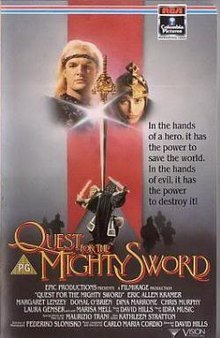
Quest for the Mighty Sword (1990)


Ator the Invincible was an Italian series 'inspired' by the success of Conan the Barbarian. Starring musclebound Yank Miles O'Keeffe, they've become somewhat (in)famous for their ultra-low production values, and ridiculous moments. It was Joe D'Amato who created the series, but lost interest when a third Conan entry wasn't immediately forthcoming, and one Alfonso Brescia picked up the slack and made the third entry himself, resulting in a strange arthouse-style picture. D'Amato hated this film, perhaps because it was someone else handling his 'baby', or maybe he just thought Brescia did a rubbish job at it. And so he decided to return to the series, to show everyone what was what...


The great king Ator is killed by vengeful gods, and his widow and child (also named Ator) flee for safety. They find refuge with a malicious goblin, who promises to take care of the child and his magical sword. Years later the matured prince Ator is the goblin's slave, and desperately seeks the sword so he may escape. Only then can he embrace his destiny and be a new hero...


Quest for the Mighty Sword is by far the worst entry in the Ator series. The first two are charming, while the third was odd and a little boring, but not bad. Quest however feels like a totally different beast. There is little in common with the first two, any previous continuity (in a series already known for spotty and footloose canon) is thrown out completely/with the dishwater.

The whole movie is a bit unpleasant, really! With no warning, the movie opens with Ator's violent death, then his wife intends to commit suicide because she's a widow (beg yer pardon?!), before being sold into prostitution, and young Ator has to grow up with an abusive goblin. The first act of this movie is an endurance test, and only when he escapes can you move on to the fun stuff.


Quest for the Mighty Sword is set in quite a misanthropic world, and a bit weird too. The movie opens with the gods demanding Ator give back his magic sword, and when he doesn't, they effortlessly murder him. It's strange that the deities of this world are so evil, and doubly strange that they're never really taken to task or punished. Everyone just collectively shrugs their shoulders, like 'What'cha gonna do'.

Quest for the Mighty Sword has leaden pacing. The first half hour has some very brief set up, then we're stuck in a cave with an asshole goblin. The next half hour consists of Ator running around, and getting in a single fight, before freeing his mother. Only in the last 30 minutes does he finally begin his quest properly, and take the battle to the villains. The film's chronology is a bit all over the place until a certain point, causing a fair amount of confusion.


The climax is a bit unsatisfying in that regard too. For all the talk of these villainous gods, the main baddie of the film is just a brief scuffle with some random dude, and anything grander is forgotten. The movie sets up so much, then culminates with such a big let-down. We coulda had Ator fight the gods themselves, but instead he fights a dumb old prince with no personal boundaries and a desperate need for skin cream. The movie then just peters out, and teases a sequel that mercifully never happened.

Ultimately this is all pretty frustrating when this is the fourth entry in the series (third if you listen to Joe D'Amato). We should be beyond the point of an origin story, especially when Ator has a different bloody origin in every movie!


The characters are bland. Ator is a pretty basic hero. Nothing special, but not terrible either. His main sidekick/girlfriend Dejamira is bland. A prisoner of the gods, she is freed by Ator, and is finally her own woman...Except she can't fight worth a damn (when she even fights at all), screams uselessly, and can't tell people anything. Comic relief Skiold is pretty decent, and makes for a good ally. Though his fate is a needless bummer, especially since it's so late in the game, and from such a weak opponent.

The villains are disappointingly weak. The so-called invincible robot is destroyed with one strike in under 30 seconds, the malevolent sorceress(?) just pouts and walks off, even though I thought she'd succeeded. Then the main baddie Gunther just decides to commit suicide at the end, meaning Ator didn't even have to lift a finger to defeat him. Probably the best villain by default is the mean goblin who dominates the first act.


The acting ranges from the competent to weak, with accents are all over the place too, with some English accents, and some distractingly modern U.S. ones. Eric Allan Kramer is one of the better performers, but as Ator he is no Miles O'Keeffe. I find him a much better actor in other things. Margaret Lenzey is amusingly bad here, decent there. Donald O'Brien is an over-the-top and grungy looking villain, while Laura Gemser is fine but sadly doesn't get to do a whole lot to do. Dina Morrone delivers an alright performance, and is a real trooper for what she has to do here (it has to be seen to be believed!). There's also Marissa Mell, in an unremarkable role.

The direction is fine, which is no surprise given D'Amato's experience, but the whole film looks unappealing. Not only are the visuals a mix of bland or unappealing brown, it often feels like there's been vaseline smeared all over the camera. The action is barely satisfactory, and consists of people being hit with a prop sword and falling down. No blood or grue, with few exceptions.


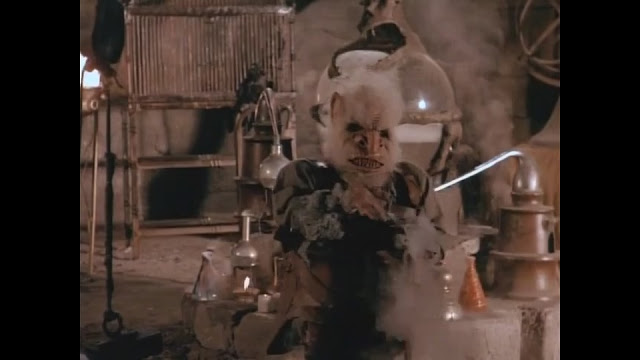
The effects are the best part of the film. They are cheesy and clunky, but fun and bizarre. There's a two-headed robot, and a Godzilla-esque dragon that kinda looks like it's melting. Lastly, the most distinctive thing about Quest for the Mighty Sword is its use of recycled props from the infamous Troll 2! Laura Gemser's now iconic goblin masks are designed well, if not convincingly, and they work quite well in this fantasy setting. Always nice seeing the Italians being enterprising.

The music here is mixed. Some tracks are great, suitably sweeping and heroic. Others come across more as goofy, and impossible to take seriously. It also spoils the ending, which I'm pretty sure is supposed to be an ominous cliffhanger, but plays an uninterrupted gentle melody the whole time.


Overall, there is nothing remarkable about Quest for the Mighty Sword. It's not terrible, not even entertainingly so for the most part. It's just all-round mediocre. It feels nothing like an Ator film, and is a sad conclusion for the series. It may not have been the best of franchises, and god knows the previous entry was weird enough, but this really signals a total and unflattering end. Maybe someday we'll get more Ator films, but only if we're lucky...

Fistful of Lead (1970)


The spaghetti westerns of the 60s and 70s were a booming period, with many colouful characters. You had the coffin-toting Django, the fun-loving Trinity (plus Bambino!), and the gadget-laden Sartana. Picking a favourite sure is tough work!


After a showdown with Mexican bandidos, the wily gunslinger Sartana ventures to the mining town of Appaloosa. There he discovers the mayor behind a shifty plan-He sends shipments of the miners' gold dust out to the city, where it's 'conveniently' raided by bandits, who blow up all evidence. Sartana begins upsetting the apple cart by egging on the bandidos, led by the crazy Mantas, and watches the sparks fly. But an unexpected spanner comes into the works with the arrival of fellow gunslinger Sabbath...


I first encountered Fistful of Lead when I saw the DVD in a local library some years back, and had a chuckle over the derivative title. Since I adore spaghetti westerns I was quick to watch it, and had a really good time! While Fistful of Lead certainly is shorter, its proper title is actually the far superior (if wordy in a distinctly Italian way) Sartana's Here...Trade Your Pistol for a Coffin.


Fistful of Lead is part of the popular Sartana series, by technicality. Those films starred Gianni Garko as the titular hero, and with a unique blend of genres, he was in 4 films altogether. Spaghetti westerns would invariably receive unofficial sequels, with Django getting dozens. Fistful of Lead is notable in that it's not part of the main series (not even having the same lead actor), but is regarded so highly by fans it's considered to be the official unofficial entry.


The plot is pretty simple, and this could be a positive or negative. It's basic enough that we always know what's going on, but the finer details and machinations going on do make it a bit convoluted in places, as you expect from a spaghetti western. With this in mind, a simpler plot was perhaps the right idea, even if it's not as grand as it maybe could have been.

The film begins bit by bit, showing us first how Sartana discovers the plan, then his sojourn to a little ghost town occupied by the bandits. We see how he operates, from his prowess as a gunfighter, to his mind games, and of course his fancy gadgets. Once this small-scale first act is over, the film opens up, with Sartana arriving in Appaloosa and beginning his own plan.


While not an outright comedy, there are plenty of funny moments in Fistful of Lead. One in particular is when mayor Spencer first meets Sartana at the point of his gun. After learning he's also the sheriff, Sartana remarks that Spencer is probably the preacher too, and he responds by smugly bleating "You wouldn't shoot a man of the cloth, would you?".


Sartana is your typical Italian western hero. Slightly amoral, with no qualms about racking up a body count. He's really only in it for the money, but he will try and do the right thing, if only in a broad sense. He often puts on a show for whoever's watching, but it's easy for we the viewer to understand. There's nothing worse than a confusing hero, and while his enemies or allies might not know what to think, we always do.

With his use of gadgets, Sartana is known as the James Bond of the West. This aspect is less pronounced than other entries, but still present enough to be distinctive. Where else can you see a bread gun in the old west? His multi-barrelled derringer is a neat weapon too. Despite his enemies having no way of knowing his gadgets (since all witnesses die), Sartana rarely reuses them. There is a great callback in a final shot!


The townsfolk are in the middle. We mainly see sexy saloon owner Trixie, who's trying to play both fields if it means more business. Then of course there's villainous would-be mastermind Spencer, and his right hand thug Baxter. He and Baxter share a sudden and ignominious end, which is fine, since let's be real, either were ever a threat to Sartana.

Mantas is a fun baddie, and loves being evil. He has some visually distinct henchmen too, so it's a shame in a way when they die. Mantas's death is a little disappointing. I don't mind how it happens, but it's so unceremonious, getting killed like just another henchman.


The last character is Sabbath, an effete cowboy who favours good literature, parasols, and other men (we guess). He doesn't show up until an hour in, which is slightly disappointing, but at least it allows for everyone else to get the development they need. And once he's in the picture, it feels like he was there all along. His relationship with Sartana is great, and they could easily share a buddy series together.


The last act is a hoot, with enough action to satisfy, and more twists than you can shake a stick at. The final duel between Sartana and Sabbath is a hilarious pissing contest, with each using their ludicrously good marksmanship, until one of them actually runs out of ammo! This leads to some creative final moments. The only problem is that it's got to end with one of them biting the dust! Sabbath is such a great character you'd hate to see him die. After the duel is done, there's a twist, but just when you think all is lost for our hero, we get the best surprise of all! This leads to a funny ending that will leave a smile on your face.


We've got a good cast here. George Hilton is a fun lead. Like Gianni Garko before him, he's a reliable cowboy who knows to not take things too seriously. Sultry Erika Blanc is a beauty as always, and does well. Charles Southwood does a lot with a little time, giving a distinct performance, while Nello Pazzafini is entertaining as the unhinged bandido.

The direction is standard, with a few neat touches. We get cool angles during duels, and a cool split screen effect. My only criticism is that sometimes the action comes so fast it's hard to tell exactly what trick Sartana has even done.


Like many spaghetti westerns, Fistful of Lead is commonly found in fairly ratty prints. While I think high quality versions exist (thank goodness!), the low quality can often be part of the fun! That is true for this film too, except for a few little issues, such as the sand actually looking like gold dust.

The music here is fun! Really it's nothing to write home about as far as Italian westerns go, sounding much like any other, but it all sounds good regardless. There's a typical western main theme, and more, including the elegant Sabbath leitmotif.


Fistful of Lead is a fun spaghetti western to check out. Obviously it's not an A-list classic, but hey, neither are most of the really enjoyable ones. The film would spawn the two Hallelujah films (unless they came first. Anything's possible with these movies), where George Hilton would have further ludicrous adventures, which I'll be sure to talk about someday soon...

Best of the Best 4: Without Warning (1998)

 
The Best of the Best series is the brainchild of Korean-American Phillip Rhee. The first two were tournament fighters co-starring Eric Roberts, and while they failed to make a huge dent in the box office, and earned the ire of stuffy film critics, they succeeded in finding the right audience. This earned the series two more sequels, direct-to-video, not only produced by Rhee and starring him, but directed by him as well!


Tommy Lee is a mild-mannered single father and karate enthusiast, teaching the local police precinct self-defence lessons. Things take a turn for the worse when he finds a woman fleeing from gangsters. Tommy fights them off, but too late to save the girl's life, and in her dying moments she gives him a strange disc. Now Tommy finds himself targeted by both gangsters and the police, and must fight to save his life, and to rescue his captive daughter...


Best of the Best 4: Without Warning is a quintessentially 90s action movie, and an entertaining ride the whole time! The story is simple, and gets off with a bang. We're introduced to the villains and their counterfeiting scheme, one of their employees realises what's going on and tries to escape with evidence, the hero gets involved, his daughter is kidnapped, etc. It's all economical and well portrayed, and gives not only plenty of tension to the film, but some heart too.

Tommy Lee is a great lead, and his relationship with his daughter Stephanie is so sweet! It gives the movie something to fight for, and feel invested in. Beyond that he's a likeable guy, and interacts well with all those around him.


Detective Gresko is your typical stern police officer, skeptical of all that kung fu, and trusting too much in his gun. He's firmly against Tommy at first, until he uncovers the corruption on his squad, and begins fighting against the real enemy.

The villains are a pair of Russian mobsters, brothers Lukasz and Yuri Slava. They're fun bad guys, who get moments of almost cartoonish villainy, like playing golf with humans as targets. Each get moments of humour and familial affection that make them feel convincing. Another villain is a cop who's friendly with Tommy at first, before it's revealed he's in league with the gang, and gets killed by his own weapon. Lucky for justice, not so much for Tommy, who's now seen as a cop killer!

Yuri's girlfriend is slightly interesting. While villainous at first, she sticks up for herself when Yuri is openly cheating on her, but soon realises that a vicious gangster doesn't actually care about being faithful. Her gradual change of heart eventually leads her to switch sides, almost too late. It comes off well, even if I did feel like shooting her myself for not doing it sooner.


The action here is great fun. There's good fight choreography, many varied encounters, and cool karate moves! Tommy not only performs hand-to-hand combat, but gets involved in some chases too, including a particularly fun one that ends explosively. It's completely ridiculous, yeah, as is him fighting off a dozen guys all at once, but above all else, it's fun. And it's presented so earnestly that you believe it, even as you laugh at the cheesiness.

The climax is a good one, shot in a fun way in a neat location. And not only has some good action, but a hilarious moment when the villains are killed.


The cast in Without Warning is good. Ernie Hudson is a great presence as the gruff but ultimately accepting detective, and has good chemistry with the lead, both as enemy and ally. Tobin Bell of then-upcoming Saw fame plays a decent main villain, delivering a coldly ruthless performance, in contrast with Thure Riefenstein's more over-the-top one. They balance each-other well. Jessica Collins is good as the femme fatale. Paul Gleason has a fairly small but well fleshed out role as the friendly priest, and Art LaFleur pops up for a brief part too. And little Jessica Huang is adorable as Stephanie!


But best credit must go to Phillip Rhee. Not only is he a competent and likeable leading man, but he also manages to juggle performing along with directing and producing! And all while being Korean too! Not only is he an extremely positive influence, but the fact that a foreign leading man is able to speak as clearly as Rhee does is laudable. On the scale of Dolph Lundgren to Jean Claude Van Damme, he is still clearly Korean (wouldn't have it any other way), but at no point is his accent so strong you fail to understand him.

The score here is made up of your typical 90s action tracks, which all fit perfectly. There's also a surprisingly nice tune playing over the credits. It reminded me of Chrono Cross, if that means anything.


Best of the Best 4: Without Warning is a great time to be had! While the rest of the series is equally recommended (and I swear I'll get to talking about them someday!), this one in particular is a favourite of mine among this period of action cinema, and well worth checking out!...