Tuesday, September 14, 2021

Beginning of the End (1957)


Overnight, the entire town of Ludlow is annihilated by an unknown force, with no traces left of the population. Photojournalist Audrey Aimes investigates en route to another story, and after getting co-operation from the military, she begins her own search, soon finding a local scientist with strange experiments. Dr. Ed Wainwright  has been using radiation to grow giant food in an effort to cure world hunger, but without his knowing, a swarm of locusts has broken in and eaten some produce, resulting in them growing to giant proportions. The insects begin attacking as they move closer to the city, and it seems like nothing can stop them...


B-movie veteran Bert I. Gordon often created giant monsters for the silver screen, from the Amazing Colossal Man, to spiders, cyclops, and alien dinosaurs (or indeed, lizards with bits of plastic stuck on their heads). With 1957's Beginning of the End however, he attempted something a little more ambitious...So ambitious in fact that out of all of his movies, this is among the cheapest as a result.

This is a by-the-numbers giant creature feature, with little to make it stand out in that regard, but where it succeeds is in its tone and presentation. Sure, it's basically a knock-off of Them, but it does enough of its own thing to feel fairly unique. The ominous tone during the beginning is well handled, and the film does have balls.


The last act has an atmospheric feel to it, even if it is a further knock-off of Them. The emptied cityscape looks great, and always convincing.

Onto some negatives, Beginning of the End has a few huge gaps in logic. Firstly, it's been two months since these locusts grew giant, and yet they've been unnoticed this whole time, even when eating an entire town.


Then there's their strength. They may be giant, but they are only insects! It's hard to believe that guns, rockets, fire, and pesticides do absolutely nothing! Where things totally fall apart is in the last act, when the military need to capture one of the locusts alive, and they do this quite successfully by use of a gas bomb. Sooo...why didn't they use them to begin with? Then later on, Ed is able to use his skill of being the hero to shoot a locust dead, despite them being immune to bullets.

And lastly there are a couple of amusingly goofy moments, like the voyeur grasshopper (he's been watching too much King Kong!), the polygraph scene (I'm not convinced the writer knew what it even is), or when the heroes throw their gas bombs, then immediately remove their gas masks.


The characters are mixed. Audrey is a great lead, carrying the film's first act very well. She's your typical plucky journalist, but she has some depth to her, courtesy of her past job during the wars.

Ed on the other hand is a dickhead! His radioactive fruit is what made the locusts grow to such deadly size, and yet he suffers from no guilty conscience at all. The most he says is "I feel I may be partially to blame for this". You're COMPLETELY to blame. Even your assistant got eaten! More than that, he uses his former army position to speak with an air of authority around other soldiers, apparently forgetting he was only a radio operator. As far as protagonists go, he's alright, but it is hard to overlook how much of this is his fault.


The military are likeable and well portrayed here. They're not just stereotypically bullheaded or nasty, which was a relief to see for a change.


The effects in Beginning of the End are admirable, if not entirely effective. The production was so cheap and quick that costumes or props was not an option, certainly not for dozens. So Gordon, heading the effects himself, bought a bunch of real grasshoppers and superimposed them onto all the action. This looks better in some scenes, and quite fake in others. Overall it works as well as it could have. Though some of the more laughable moments are when they climb buildings, and we can tell they're smooth postcards.


Reliable star and B-movie stalwart Peter Graves delivers a fine performance, while Peggie Castle does a surprisingly good job as the love interest/defacto protagonist, and Morris Ankrum is good as the stern but levelheaded general. No complaints here. Kind of a shame there aren't any cheesier moments of overacting!


Beginning of the End is a surprisingly good time! It hardly reinvents the wheel, and covers all the same territory you'd expect, but it does it in such a good way that it's hard to dislike. And the effects are good for a laugh too. All in all this is a success for Bert I. Gordon...

Monday, September 13, 2021

Tintin and the Mystery of the Golden Fleece (1961)


Young roving journalist Tintin is relaxing with his friends Captain Haddock and Professor Calculus, when the Captain receives a letter concerning an old friend. The old sea dog Themistocles Paparanic has passed away, leaving the rickety old boat The Golden Fleece to Haddock, imploring his old friend to see the worth in this jewel of the sea. Far from grateful, Haddock is about to destroy the old thing, when a suspicious offer from businessman Anton Karabine makes Tintin and co. change their minds. Together they sail from Turkey to Greece, in search of the answer to the mystery before less scrupulous hands get there first...

Out of all the famous comic series' that litter France and Belgium, some have gotten their fair share of movie adaptions (with good ol' Asterix being a mainstay), but one that hasn't is the adventures of Tintin. His only big budget Hollywood outing was in 2011, with no follow-up, and there aren't even any films coming out of France! That wasn't true in the past however, as we got a couple in the 60s. Tintin and the Blue Oranges I have already reviewed, and have wanted to see its predecessor for a while now. Having finally seen it, it didn't disappoint!


This is a fairly simple movie, but in a good way. The whole thing is such a nice and pleasant European tour that it wasn't until an hour in when I realised, I still had no idea what the overall plot was. Now that I've finished, I'd say this is a minor annoyance, but it doesn't harm the film overall. It's still a nice adventure that never gets dull, and the central mystery is a good enough hook to keep your interest until you get all the details.

There are numerous great moments on display, from either the larger than life characters, or the action sequences they get involved in. The climax is great fun! Everyone gets to contribute. Snowy valiantly lies down on a fuse to stop it going any further, while Haddock and the others have to break out of captivity and get rid of the bomb.


The heroes here are a great bunch. Tintin is a decent idealistic hero, while Captain Haddock is loud and blustering, but goodhearted. Unfortunately Professor Calculus is out of the action for much of the picture, but he returns at just the right moment, and it's like he never left. Thomson and Thompson also appear, and likewise make the most of their limited screentime.

The villains are a weak point though. Karabine is your typical Tintin antagonist, and gets a couple of good moments, but with an hour separating his appearances he never really gets the time to do much. The remainder of the villains are just a random assortment of heavies, who all feel like they should have more to them than what we get. As it is they all blend together.


The film is chockablock full of fun dialogue. Tintin makes good remarks like "I don't trust his way of mixing feelings and figures". While Captain Haddock is naturally the life of the party with his loud streams of insults, sure to knock any baddies down more effectively than a punch.


Onto the acting, Jean-Pierre Talbot does a fine job, and he manages to be a good protagonist even if he does threaten to be overtaken by the more distinctive supporting cast. Georges Wilson is perfect as Captain Haddock, like a comic strip come to life. The same goes for Georges Loriot as Professor Calculus, and the perfectly synchronised pair playing the Thom(p)sons. Everyone else does good jobs, with varying degrees of calm and understated, and over the top. And let's not forget the pooch who plays Snowy! What a good boy he is.


The soundtrack is great. Lots of jaunty music, and authentic Mediterranean pieces.

Golden Fleece is filmed on location in Turkey and Greece, and is always gorgeous to look at. Despite its globetrotting though the whole production has a charmingly low-fi feeling. This probably wasn't the case, but I got a nice homely feeling from it all, like it was all a bunch of mates getting together.

One last thing to discuss is the end credits, which are a delight. There's some hand-drawn Tintin figures, with some added motion and effects, to really liven things up. I also liked the snazzy wording present, as well as the occasionally cheeky credits.


Tintin and the Mystery of the Golden Fleece is a great time to be had! It's not a perfect movie, but it is of the comics it's based on. Definitely worth checking out...

Eurovision Song Contest: The Story of Fire Saga (2020)


For as many years as I can remember (2009 if we're being pedantic) I've been a Eurovision fan, even if I wasn't able to watch it every year it was on. Some years have been better than others, and while there has been a growing attitude that it's not as good as it once was, you've still got plenty of classics even in recent years.

Eurovision Song Contest: The Story of Fire Saga is a movie I doubt anybody was looking forward to. How do you make a movie based on a contest? What next, a theme park ride? The project starring Will Ferrell just made the idea all the crazier. Expecting any American to like or understand Eurovision is already a tall order, but someone as goofy as Will Ferrell headlining this? Disaster, surely! That's when this movie surprised everyone though, by actually being really good!...


Lars Erickssong and Sigrit Ericksdottir are childhood friends, both inspired by the music of ABBA and and determined to one day compete in the Eurovision Song Contest. Their band Fire Saga is relegated to playing low-end gigs in their dull fishing village, with no relief in sigh, until by sheer luck they manage to qualify for the qualifying competition. After a freak accident results in Fire Saga being the only act available, they are the winners by default, and head off to the main contest, hoping the world is ready for them...

The Story of Fire Saga is a surprisingly enjoyable time!         And coming in a year where we didn't get an official Eurovision, due to unforeseen circumstances, it turned out to be just the treat we all needed!


The film has a good sense of humour, with many funny moments. Though the comedy can get a bit gratuitous at times though. These moments aren't all bad, but it kinda felt out of place with the rest of the otherwise innocent movie when characters give themselves cameltoes, or graphically describe their dicks, etc.

Some of the best moments are the hilarious Icelandic-isms, the running joke at America's expense (Damn, Will Ferrell can be savage!), and of course Olaf, the 'Ja Ja Ding Dong' guy.


Where Fire Saga really impresses is in how off-the-wall strange it gets at times! I won't spoil how, but sufficed to say there are at least 3 different moments that'll have your jaw dropping! It's a delight, since you rarely see mainstream movies be this weird or unconventional.

The film is paced well, though a little long at 2 hours, and it almost felt like it had two climaxes. Still, it breezes right by, and never once bores you.

This is a very good looking movie, and Iceland is spectacular as always. Even in tiny boring villages you've got the most amazing sights, played to amusing effect here.


The characters   Lars and Sigrit are good protagonists, both cute and awkward, and with varying levels of goofiness. Lars believable flaws, but without ever being too much of an asshole, while Sigrit is adorable, especially in her belief of elves.


The only thing that had me scratching my head is their age! The film is clearly set in the present day, and the duo's childhood is clearly linked with ABBA's Waterloo performance in 1974...But that was damn near 50 years ago now, so how old are they?! That lines up with Will Ferrell's actual age, but if these two are actually as old as that, it would just be plain depressing, not to mention unlikely. If Sigrit has been waiting for 40 years for Lars to ask her out she'll be menopausal before the first date!

Russian contestant Alexander Lemtov is a good mix of suave and kinda creepy, not to mention obviously...errr, popular in Greece. He makes for a good foil, with many amusing moments. The Greek singer Mita is a sultry minx, and insightful too, always ending awkward moments as soon as they are created.


Onto some minor points. Graham Norton's presence really irritated me. Don't get me wrong, normally I like the guy, but here he's uncharacteristically mean-spirited, not to mention annoying with how much he talks over the action. Although apparently that's actually what British Eurovision hosts have historically done, just mocking everything the whole time. Sounds like they're just being assholes!

Also I found it weird just how unpopular Fire Saga are seen as, when they're actually damn good singers! The only thing they're guilty of is stage accidents, which are barely even their fault. I guess it's one of those movie things you just have to overlook. They've gotta be seen as the underdog, but have to actually be good enough to enjoy watching.


The acting is all good. Exaggerated in many ways, but always entertaining, and the accents the two leads put on are never distracting or bad. Though Pierce Brosnan's performance comes across as comically Dutch, probably not intentionally. As for the singing, it's spectacular! Being a movie, there's a bit of behind-the-scenes magic going on. None of the actors here are actually providing their voices for their songs, with the exception of Will Ferrell (who I'm seriously impressed by!), and McAdam's vocals being mixed with Molly Sanden's, the predominate voice.

The music is the best element to Fire Saga by far! Each of the songs feels like a spectacle, and it's a shame we only get such short snippets of each! I bet you if they released a soundtrack of this movie it'd do gangbusters. Many of the tunes are reminiscent of past Eurovision acts or trends, and are often dead on! They're neat tunes too (minus hip hop, which I rarely like). The showstopping performance is My Hometown at the end.


Outside of these tracks there's still a great soundtrack, from neat or effective licensed material, to the score, which has some really good tunes on it. And last but not least is the comedy song Ja Ja Ding Dong, which is a hoot.

The film's overall portrayal of Eurovision is really good, too. Respectful, accurate, funny, and more. 


Eurovision Song Contest: The Story of Fire Saga is a great time to be had, for music lovers and general film fans alike. Considering I am usually a grumpy young man about the state of modern movies, it's always good when something is able to pleasantly surprise me like this...

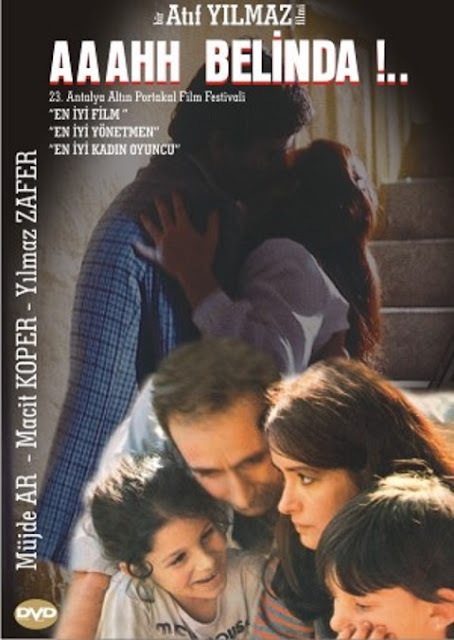
Aaahh Belinda! (1986)


Atıf Yılmaz was a living legend in the Turkish film industry. His forte was dramas about the human condition. [Naturally he was often not working with the money or resources he needed, but it's a testament to his skills that he still managed to turn out much loved classics. He kept going strong even during the 90s, a time when the Turkish film industry wasn't what it once was. As far as I know, this is my first time discussing him directly on the blog, mainly because I don't normally watch those kinds of films. I prefer less of the dramatic Oscar material where widows weep and men die, and instead more of the cheesy pulp fare. Y'know, basically all of the stuff Turkey is ashamed of, instead of what they're proud of. But I'm always interested in broadening my horizons, and part of being a film historian is watching everything. So with that I'm diving into the amusingly titled Aaahh Belinda!...


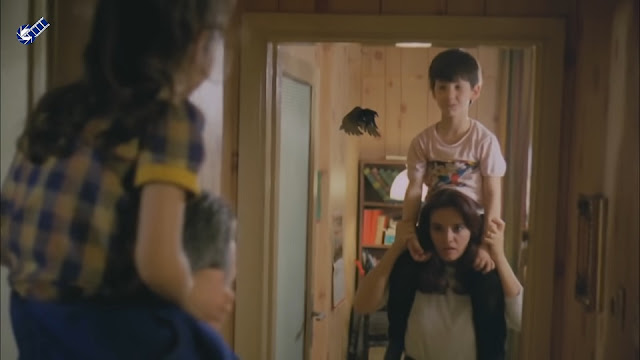
Serap in an independent woman working a = but unrewarding/hectic job in TV commercials. One day, during the middle of a shoot, her shooting studio vanishes, and Serap suddenly finds herself living inside a popular soap opera, as the traditional/submissive housewife Naciye. Saddled with a husband, kids, and various responsibilities, Serap tries to figure out what's going on, and juggle everything in this new life, and hope she gets home before she goes crazy...

Aaahh Belinda! is a film I've seen twice now. The first time was a couple of years ago, when the title immediately lured me in. I was a little disappointed to not get what I was expecting, but I did succeed in putting that out of mind and enjoying the film for what it was, and I've been eager to revisit it for a while now.

Belinda is a social commentary on the place of women in modern Turkish society, focusing on the television industry, and on conservative home life. Serap is an ardent feminist, and has a happy sex life despite being unmarried, before suddenly finding herself in a more submissive environment, where values begin at home, and women 'know their place'. At first this environment is anathema to a woman such as Serap, and even the name Naciye comes from a masculine one (Naci), compared to the singular Serap. As time goes on though she comes to accept it in certain ways, while still remaining independent in others.

The story focuses on how women from such different social conditions live   The movie is very open-minded for its time. Nowadays Turkish movies don't really worry about limitations, and show whatever they like. But for a movie back then to show a woman being sexually open (within reason) and not shaming her for it is a surprising thing! Just goes to show how ahead of his time Yılmaz was.

Then there's Aaahh Belinda's commentary on acting. It could be an allegory on the lengths actors have to go to truly immerse themselves in their roles, becoming their characters in essence. As soon as Serap gets comfortable and accepts her new life, that is when she finds herself back in the real world, in another shoot. A different one from before, which I feel helps the ambiguity of whether all this really happened or not.

Overall, I think the moral of Aaahh Belinda is that Serap likes being who she is and doesn't intend to change herself, but living how the other half lived (so to speak) did teach her a few lessons, even if it wasn't the lifestyle for her.

While it has plenty to say, this isn't a dry and dusty movie. There's plenty to laugh at, and to amuse. These range from husband Hulusi's repeated attempts to get it on with his 'wife' (all of which end in irate slaps, or interruptions from kids wanting bedtime stories), to Serap's efforts to convince others of her situation, which immediately gets her committed to a mental institution.


The direction here is good. The film is shot in a very close-quarters way, but still manages to look good as a film.There are some excellently framed shots, and there's a level of effort here that means this/Belinda never resembles the soap operas it's imitating].

As with many of Yılmaz's films, this was made on a much lower budget than would have been ideal, but he always managed to craft stories around his means. So for as high concept as this movie can get, it never needs to get too flashy in a way that would spend millions of lira. If I had to pick a personal complaint I had with the film though, it'd be that it's not weird or fantastical enough. I don't see this as an actual problem with the movie, just a hangup for me. The plot is so normal that if you cut out the framing story you wouldn't even notice. If there'd been more of a fanciful streak throughout, I would've appreciated it more.


This is most evident in the ending, which people like to mention out of context. The heroine is transported back to the real world, wherein she is attacked by a giant bottle of shampoo! Sounds crazy, right? I can understand how a scene like this gets brought up as a highlight, but in context it is a bit random, and only at the very end, and there is a reasonable explanation, unfortunately. It's a shame, because if the movie embraced this side more often it would've lived up to my expectations for it.

The cast are all good here. Müjde Ar is a nice lead, and makes for a fun fish out of water. She's a little soppy near the end, but this isn't a huge deal. Macit Koper is funny as the masculine husband, who you'll feel like slapping sometimes, but is never too unlikeable. Yılmaz Zafer does well in his role too, though gets less to do as the movie goes on. The actor playing Naciye's father does a good job in his short screentime at the end.

The music in Belinda is fun. The main theme is a fittingly commercial jingle, while the remaining tracks all work well. The score does get a bit quiet at times, with many scenes playing over silence, but this isn't necessarily a bad thing. Only if the movie feels silent as a result] and this doesn't.


Aaahh Belinda is quite a good time. It's not for everyone, but I'm sure there's a wide audience it'll appeal to, and I found it worthwhile...

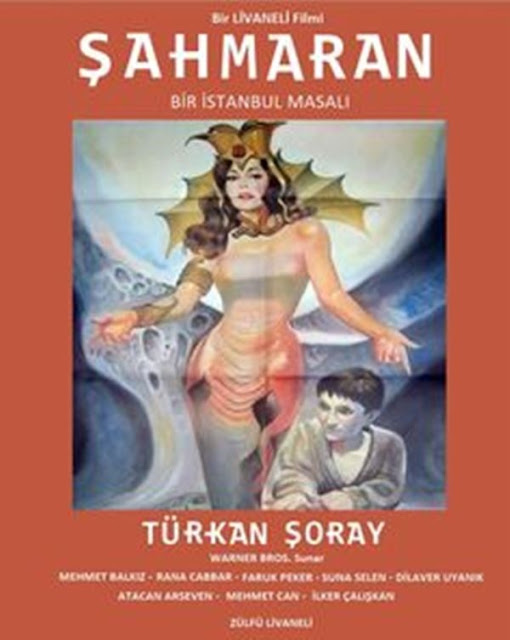
Åžahmaran (1993)


I've heard a bit online regarding the 1990s as a dry spell in Turkish cinema, with some sources even going as far as to say there were no Turkish films made during this period at all. Ummm, no! This certainly was a period where things were in a bit of a lull. The video and TV market was more popular, and the film sector wasn't as strong as it had it its heyday, but things weren't completely grim. Can you really call a cinematic period a dry spell when we get fantasies about giant snake women in Istanbul?...


Yusuf is an imaginative young boy who dreams of the snake queen, Åžahmaran, and often goes searching for artifacts in some old ruins. One night he finds himself lost in the complex, and is discovered by a band of antique smugglers, who realise they must keep this intruder prisoner, or else their operation will be busted. Yusuf is angry, but soon grows attached to his keepers, namely the beautiful ringleader Sultan. Together they swap stories of the snake queen, and how her own encounter with a boy led to her death...


Åžahmaran is a magical realist film, weaving together a story of boys and thieves with a fantastical world of snake women, imps, and nefarious sultans. This is a genre I really like, and also strive to create in, but also a genre that can can piss me off if done poorly. This is because no-one wants to watch a boring fantasy, and if you have too much of the real world and not enough fantasy, the whole thing can just go to pot.


The story is a bit of a strange one, but reasonably well written. It's never boring despite its confined settings, and there's enough intrigue here, even if it is presented in a bizarre way.

Where the film fails to impress is how it takes halfway through the film before the fantasy sequences even start. They do play an important role in the story, as well as thematically, but it takes so long to get to them that it almost begins to feel like false advertising. There's not enough of them for my liking either, to the point where they skirt dangerously close to being an afterthought.

The last act is a bit of a downer. It feels inevitable, and sure enough the events in the real world end up mirroring those of the fantasy story. I guess it all has a place in the writer's vision, but it felt a little unnecessary, and I didn't quite understand the point of some scenes. We're then given an ending that doesn't seem to know when to end, with a few confusing moments, before finally getting a nice fantastical moment to conclude on, that does impress.


Yusuf is a good protagonist, adventurous, resourceful, and clever, but is still believable as a kid. His likeability takes a serious downturn after his actions in the last half hour though. Despite throwing completely understandable temper tantrums to be allowed back home, and despite the great care taken by the smugglers to send him home without him knowing their location, Yusuf decides he misses his new friends, and goes poking his nose around the ruins again, leading their enemies straight to them, getting them all killed! This kid is a little shit! You only had one instruction, stay away, but you didn't listen and now they're all dead! Their blood on your hands, Yusuf!


Sultan is suitably enigmatic and sexy, while also having a maternal streak. She gets along well with Yusuf, who is a typical boy around her. In one scene he can't help but grab her boobs! He's lucky he's still breathing! She's nice enough, and shares a good friendship with Yusuf that always feels convincing.

The two henchmen are an amusing pair. There's the older more levelheaded guy, and the crazy headstrong one, who starts out a little homicidal in temperament, but becomes a funny presence (especially when he speaks in English). Overall these guys are not really developed enough. They appear just enough for you to come to like them (despite technically being kidnappers), but not enough to actually really know a darn thing about 'em. Their deaths are a bummer, and come too quickly. The film wastes no time. They aren't even able to react to Yusuf's surprise return with "Mate, you're back! Aww, you shouldn't have returned, but were' glad to see ya." before they get abruptly gunned down.


We don't see much of the villain, but his scenes sure leave an impression. Every now and then we cut away to a weirdo yelling at his dolls, throwing knives at them, and crawling around the room like a maniac. He turns out to be a crime lord with an axe to grind with Sultan. I guess it's a good thing that such a character is distinct rather than just some boring guy in a suit, but man did they ever go in a weird direction with him!


I'm not entirely sure Åžahmaran works as a coming-of-age tale. Considering it contains no less than three shootings and stabbings, and one graphic snake lady execution, it's probably not suitable if you're a square, but I'd say most kids are bloodthirsty enough to be fine with it. Whether they'll get anything out of the story though I'm not sure. They'd probably just go "Mum, change the channel".


The scenery here is really good. The movie is shot on location in Istanbul (technically every Turkish movie is shot on location, since sets were a luxury they didn't have), with the ruins and caverns being shot in the Anemas Dungeons, and Basilica Cisterns. The ending shot of the rising boat is well handled too. It looks like a mix of a model boat and a real location.

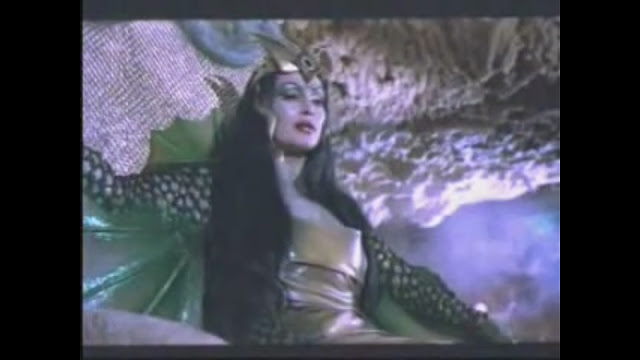
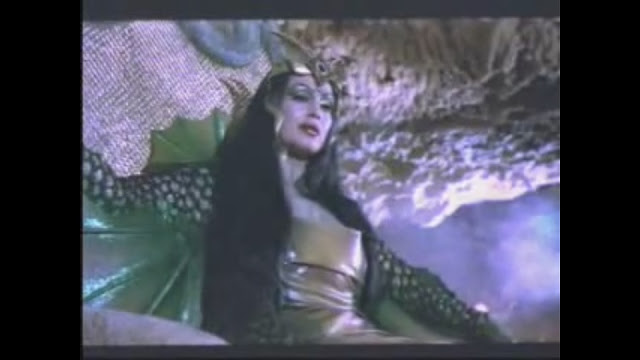
The effects here are neat. There's not a lot, but what there is has to be big, and has to convince, and it certainly does. The titular snake queen is a great sight, and they spared no expense in her length too. I'm quite curious how they made it! My guess is that it was a repurposed kiddie tunnel, covered in a painted green tarp, and glued to the actress. Whatever the case, it looks convincing. The effect when it gets chopped doesn't pull any punches either. It's surprisingly grisly. And they do it twice too, meaning they must've been confident it'd look good! They were correct.


The cast here all do a nice job. Turkish beauty Türkan Şoray is a good lead, and it's nice to see she was unafraid of weird roles. Mehmet Balkız carries the film decently enough, while Faruk Peker and Dilaver Uyanık are entertainingly weird. Atacan Arseven on the other hand just seemed goofy. Rana Cabbar has a smaller but effective emotional performance as Yusuf's grandfather. Dwarf actor Mevlüt Demiryay makes a brief appearance as an imp, and is indeed the reason I even found this film. I wished he got more to do. After all, when is more imps ever a bad thing?

The score to Åžahmaran is neat! We've got fancy orchestral pieces, which lend a grandiose fantasy atmosphere. Then we've also got some synthesiser pieces, that sound cool and set the mood, without being over the top enough to be distracting.


Åžahmaran highlights both the highs and lows its genre can produce, and is an interesting film if nothing else, with some good visuals. It's not the best, and I wouldn't recommend it to most people, but if it's your kind of movie, or it sounds like it appeals to you, by all means watch...